Shophouses of Singapore: Beyond the Facade · ManMoMedia · 2026
Interview with Hong Xinying writer and content director.
By Ben Kee — Founder of KWHD Singapore
Hong Xinying is a writer and content director at a travel company in Japan. Her new book, Shophouses of Singapore: Beyond the Facade (ManMoMedia, 2026), co-authored with longtime collaborator Kissa Castañeda, goes past the candy-coloured frontages of Singapore's heritage buildings and into the lives of the owners, architects, and entrepreneurs behind them. The launch filled the ballroom at Mandala Club; the book is now on shelves across Singapore and heading to stores worldwide.
A self-described serial hobbyist — she’s interested in writing, painting, photography and language learning — Xinying sat down with us to talk about the craft underneath it all: why curation comes before writing, why rewriting is the real work, what AI can and can't do for a young writer, and why living in Japan, where print refuses to die, is “such a joy and blessing.”
1.Were you always a writer?
I was always interested in reading and writing, even as a child. At university my major was English literature, so I already had the habit of reading and writing a lot, and learning from the best people in the business. Funnily enough, I almost never read magazines before I entered the magazine industry — it was that interest in the literary arts that dovetailed into a more editorial, mass-appeal style of writing. In contrast to people taught formally how to write as journalists, I was adapting my own style along the way. I probably have a style — but I did not consciously build it.
2.Digital writing versus print writing — is it really a different craft?
I joined the industry at a very interesting time, when things were beginning to go digital. The magazine business couldn't be purely print anymore, and having a digital team focused on the website was a whole novel thing — some teams didn't understand you'd need a digital writer versus a print writer. Instagram videos were new. For digital, you have to consider how people consume media: not just SEO, but how you write a headline that captures attention, with the keywords in it. A print writer thinks about what looks beautiful on the page — a headline that's short, a bit vague, evocative. Online, that doesn't work. It's not that a print writer can't be a good digital writer. You just need awareness of it.
3.Walk me through your writing process.
I started as a writer-editor for a magazine, so curation was always part of the process — curation and material-gathering come first, and the writing comes later. And I made rewriting a distinct part of my process: the way I write is I rewrite a lot. I don't necessarily write the introduction first. I write whatever comes to mind, shift paragraphs around, and sometimes write the introduction last.
4.You wrote this book with a co-author. How do two voices become one?
Kissa and I have worked together for a very long time, so we know our tones of voice match and our tastes gel easily. Without even deciding on a house style, we generally know what we're looking for — that's what makes the writing cohesive even though we're two different people. We also both wrote for Tatler, a luxury magazine, so the bar was already set at a higher standard. And honestly, we're fortunate that writing comes naturally — it's more the procrastination. When a deadline comes in, then you write. But in theory, we write fast.
5.How did the book itself come together?
Because we were creating a coffee table book, the visuals came first. As long as we could get permission to feature a project, have photography shared with us, and the person was available to be interviewed, it was in — then we'd backlog the interview replies and materials and write in sprints. We approached venues one by one, which is why it took such a long time; when someone wasn't contactable, we'd find another project. As for who wrote what, the answer is a bit boring: if I contacted the person, I wrote that piece — though with clashing deadlines we'd sometimes take over each other's. Most photography was generously provided by the venues. For the few exceptions, our good friend Franz stepped in and shot additional photography — some of his photos are now retailed as a little postcard bundle.
6.What would you tell a young person who wants to write?
Read as much as you like, as widely as you can, across genres — fiction or nonfiction — and discover whether you really enjoy writing. For me, and I don't know if it sounds cheesy, I've always had this very strong urge to make things. Whether I'm writing, drawing, painting, taking a photo, or doing some handicraft — I just feel the urge to make things. If that sense of compulsion is strong, follow it. But the flip side: I'd say don't choose writing as a career. Write for yourself, put something out as a passion, and see where it goes. Editorial work is really challenging — you're a do-it-all. You're an interviewer, a writer, a PR person finding contexts for people to give you leads; you socialise, you do Instagram. If all that feels like too much, it's better as a passion project.
7.That sounds discouraging — is it?
No — because beyond that, just do it. Whether it's a blog, your own journal, a social media account, or writing a book from scratch — there are so many self-publishing avenues that weren't around before. If you really want to do it, just do it. If you think about how difficult it is, you'll never do it. Just like putting together this book. Try, share it with early readers or a publisher, and if you get good feedback, make it happen.
8.How does someone actually get better at writing?
Editing and feedback are important, and learning to see how others write. Newspaper and magazine writing is very interesting to observe, because they have to capture a great lot in a short amount of time. People might think fiction is the higher art, but editorial style is rigorous — for someone who doesn't know where to start, it could be the place to go. Observe how they open with catching paragraphs, how they tease at your interest without giving the plot away, how they keep things concise. Anyone can write, honestly. It's the art of editing — that's the key. And in publishing now, you edit your own work; you're taught not to give your editor a rough draft. You're training your own writing and editing skills at the same time.
9.How do you edit yourself when you don't know what you don't know?
Something I observed, and was also given as feedback: it helps to just read it out loud. If it feels like it's going on forever and ever, cut it down. Observe how the sentence flows when you read it out — is it interesting to you? In editorial work we also write scripts, for MC-ing events and for videos, and in scripting yourself and reading out loud, you realise what good writing is.
10.Where do you stand on AI and writing?
Think of it from the perspective of blank-page syndrome: having it help you is better than not starting at all, if you're really stumped. The other way is to not think too much about quality — just write and write and write, and when you're done, have AI or a friend look at it and review from there. But you're right that if you're too reliant on it, you lose the muscle. Writing is analytical thinking — deciding what to include or exclude, organising your thoughts as you go. By choosing to write more and rely on AI less — not that you don't use it — you're still flexing your analytical ability, your original side. At my day job as a content director at a travel company, we do use AI to some extent — catch-copy ideas, more variations. Honestly, it's easier to tell AI to rewrite something ten times than to tell a junior writer that. But that's the drawback: if you always rely on AI instead of training the junior writer, you lose a whole generation that could become better writers. The gap is actually quite concerning.
11.You live in Japan, where print refuses to die. Why is that?
Japan is very interesting — the idea that print is over never really took hold fully. Magazines close down, but so many still exist, and so many companies believe you need printed collaterals. As a writer and editor, that's a very beautiful thing; to live in that environment is such a joy and blessing. I'm not well-versed enough in the sociology to say for sure, but my inference is there's a very strong cultural pride, and a strong sense of the importance of consuming media — novels, comic books, magazines.
12.How do you keep your own craft sharp?
Ironically, I never liked keeping a journal or diary — to me, writing my own diary feels like the most mundane and boring thing to do. Instead, recently I've challenged myself to do more painting, to flex a different part of the creative muscle. And I've been trying to write in Japanese — not to master it, but to use it better. I'm so consumed with writing and editing in English that sometimes I need to step outside for a bit, do something different, to find inspiration again. I've been trying to write in an editorial tone in Japanese, reading Japanese magazines for reference — short movie reviews, magazine-style itinerary lists.
13.Does the language change the writing?
It does — I suppose that's why authors like Haruki Murakami were so fundamental in encouraging writers who came after him to step outside the box. And like any language, the way it's used now keeps changing, adapting to slang. There was an author here who received flak for using AI in her work — but she only used it to script the responses from an AI character in the story. I'm not opposed to it; just always conscious of using it creatively. As an English literature major, that's actually what encouraged me to learn more languages — you want to better understand what the original intention was. English, Chinese, Japanese now, and I learned French, though I'm very bad at it — I can read a bit.

At the launch — copies of the book in hand

Shophouses of Singapore: Beyond the Facade — image courtesy of ManMoMedia
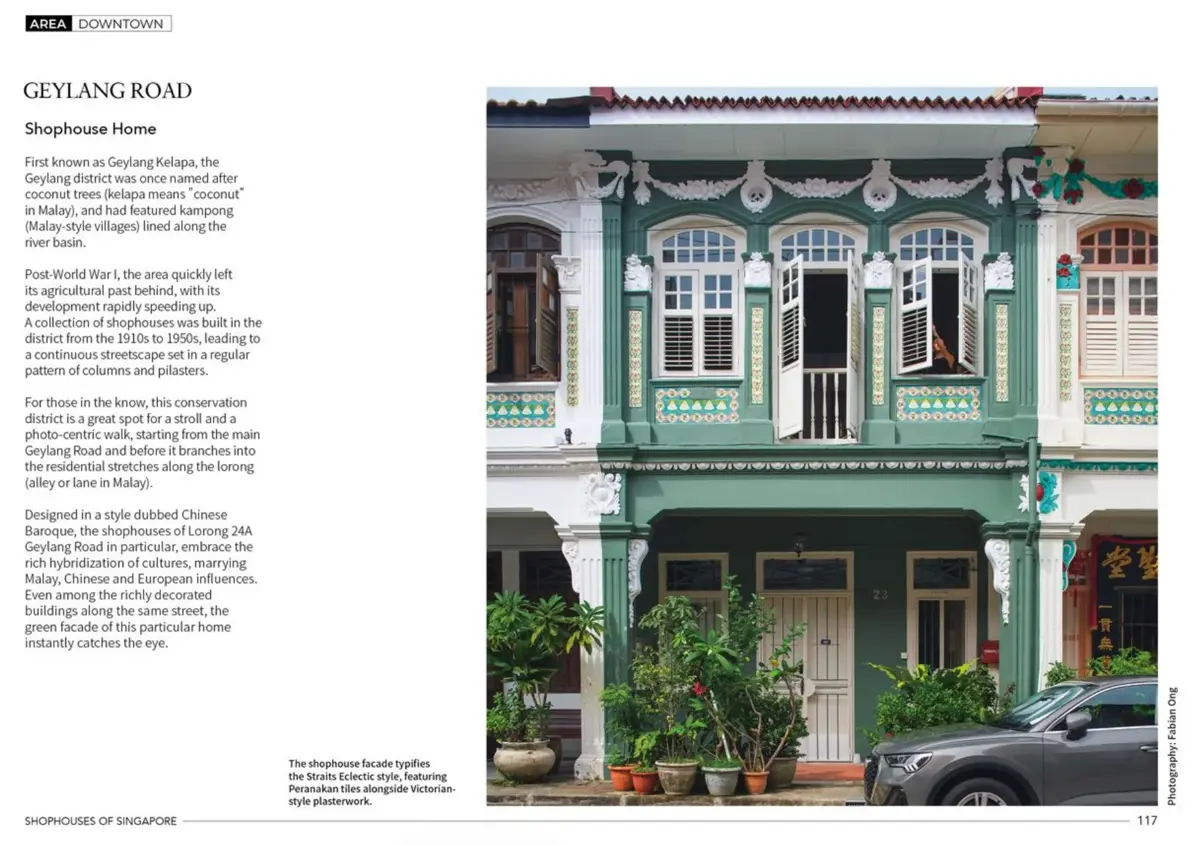
Inside the book: a Geylang Road shophouse home — courtesy of ManMoMedia, photography Fabian Ong
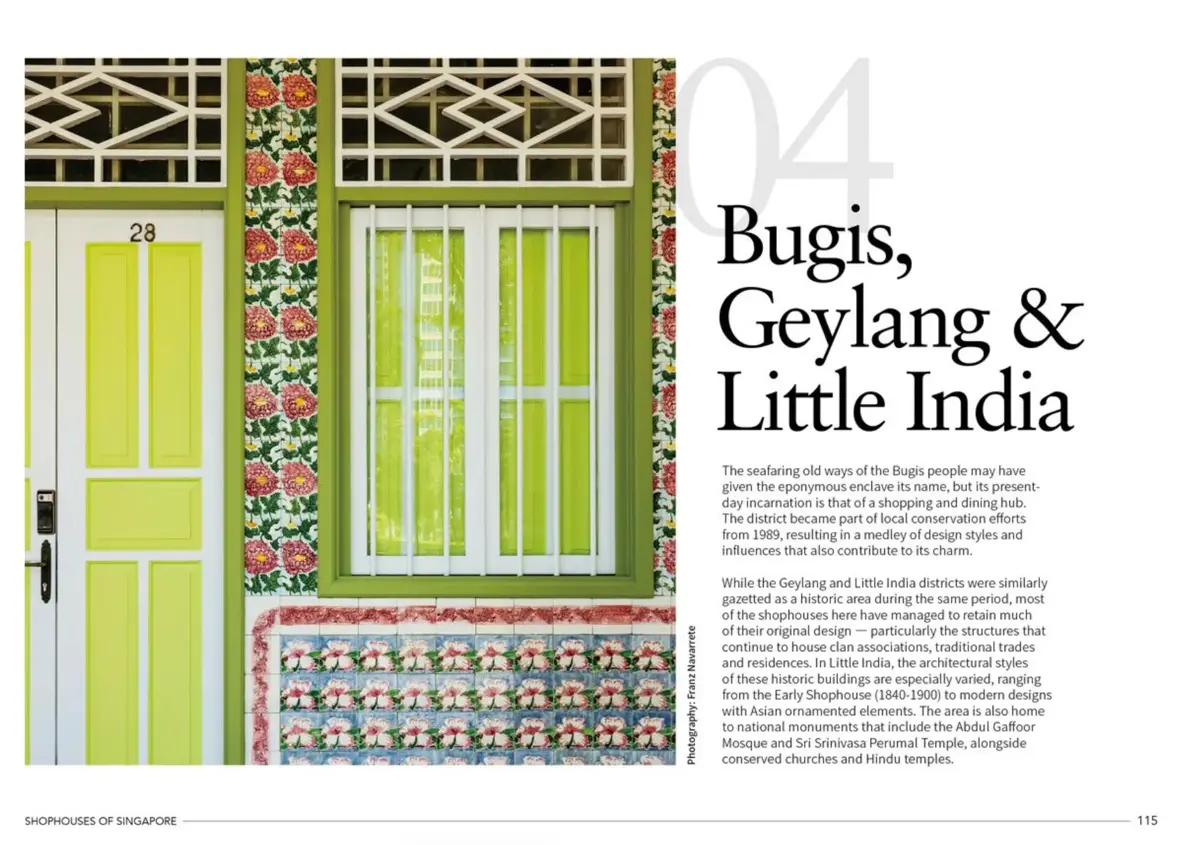
Chapter 04: Bugis, Geylang & Little India — courtesy of ManMoMedia, photography Franz Navarrete

Beyond the facade — a shophouse tucked behind the greenery
Connect

Hong Xinying
Currently based in Kyoto, Hong Xinying is a content director at a travel company in Japan. Her new book, Shophouses of Singapore: Beyond the Facade (ManMoMedia, 2026), co-authored with longtime collaborator Kissa Castañeda, goes past the candy-coloured frontages of Singapore's heritage buildings and into the lives of the owners, architects, and entrepreneurs behind them. The book launch and panel discussion was held at a ballroom at Mandala Club; the book is now on shelves across Singapore and heading towards stores worldwide.

Ben Kee
Ben is the founder of KWHD Singapore, a creative and maker studio in Singapore. He writes about craft, makers, and the spaces they build for Scaffolds Stories.