Cloudy in June — Interview
(forms in [progress) and self-discovery] · NUTSHOUSE, Kyoto · 13–20 June 2026
By Ben Kee — Founder of KWHD Singapore
In June 2026, ceramic artist Cloudy in June staged her first solo exhibition, (forms in [progress) and self-discovery], at NUTSHOUSE (夏屋) — a small creative space tucked into Kyoto's Kita ward that describes itself as a place “where everyone is a little nuts.” Over a week, the show gathered a year's worth of her work: wheel-thrown bowls and cups in black and dark green clays, grit-flecked navy glazes, and a teapot with a handle bent from garden branches, each piece signed with a small cloud carved by hand. The opening weekend featured an artist talk paired with a tea tasting, followed by a reception party.
We sat down with Cloudy among the finished pieces — a spider had quietly taken up residence in one of the bowls — to talk about how it all came together: a birthday-gift pottery course, a rigorous Japanese kneading exam, learning teapots from the internet, and why trimming might be the most cathartic part of the whole craft. What emerges is a portrait of a maker who, a year in, is still surprising herself: a PhD student who never planned to enter the art world, discovering her own body of work by seeing it gathered in one room for the first time.
1.How did your journey with ceramics begin?
Surprisingly, not with hand-building. I started on the wheel — a hobbyist course I took as a birthday gift to myself, an introduction to wheel-throwing for about a month and a half. I learned the very basics. Then six years later I came to Japan and joined my current studio, and everything started over.
2.What drew you to clay in the first place?
There was a pottery studio nearby, and I thought, okay, let me do something creative. So I signed up. It was fun, it was cute — I got to play with dirt. I think that's when I first understood how much I like the visceral part of making. As a kid I used to draw and paint a lot, and I've always loved sketching with graphite and charcoal — there's something about the feeling of graphite hitting the paper, quite textural, that I find really cathartic. Clay is the same. I was an art minor in college — I did sculpture, metalworking, woodworking, but never clay. And now this has taken over my entire existence.
3.What did starting over in Japan look like?
The studio doesn't let you use the electric wheel until you pass a kneading exam — on the wheel, there can be no air bubbles in your clay. My technique was more Western, so I had to learn kikuneri, chrysanthemum kneading — a big spiral wedging. It's a legit test: they watch you knead a large amount of clay, then cut strips away, and every hole they find is points deducted. It took about a month of consistent practice. I'd knead until I tired myself out, then make a little hand-built pot.
4.Is there a divide in the studio between hand-building and wheel-throwing?
It's half and half, and I think it's just personal preference. I really respect the hand-builders — they make amazing things with just their imagination. One guy makes cups from different coloured clays so they look like sediment, mimicking the layers of the earth, with a dinosaur-head fossil embedded in the middle and a clear glaze so you can see every stratum.
5.Does the wheel produce a more perfect form?
Not necessarily. Your technique is your technique. There are people on the wheel who make lopsided things, and hand-builders so laser-focused their work comes out perfectly shaped. It's a preference — and how you hone in on it is you.
6.There's a cloud carved into the base of every piece. What's the story?
In French my name is Claude, but in Japan they call me Cloudy — so it fits. When I joined the studio they asked for a maker's stamp and I just drew a cloud. Okay, I guess this is me now. It's not a physical stamp; I carve each one individually by hand. Practically, it means the studio knows whose work is whose coming out of the kiln — but it also marks you, like a signature on a painting.
7.What are you working with — clays, glazes?
I mostly use what's available at the studio — white clay, red clay, and recently I've been asking for the black clay. The black clay has so much personality, so much character. Sometimes we work with porcelain, which is the only wildcard because it's so buttery, but between the red, white, and black I don't feel much difference — black is just a personal preference. For glazes, some pieces are dipped, some painted, some sprayed — I use a spray gun, make a little tent outside, and spray away. I painted the half-glazed ones because I wanted that half effect. I was experimenting and I wanted to play with the spray gun, so I did.
8.The matte, gritty finish on some pieces — how did that happen?
The glaze is a navy liquid with grit in it, like sand. The first time I used it I was confused — you expect glaze to dissolve, but it stayed solid. I glazed the inside first, so the grit landed in the bowl; by the time I did the outside, it had sunk to the bottom of the bucket. A happy accident — but I liked the effect so much I recreated it deliberately for a more matte, uniform outside.
9.Talk me through trimming.
Trimming is my favourite part. I throw off the hump — maybe five or ten kilos of clay, using a little at a time — then wait a day for the piece to get leather hard. I put it back on the wheel upside down and trim with metal tools: refine the shape, develop the foot, trim out the inside. The reductive part I find really fun — the resistance, something tactile about it that I really enjoy. Though if you go overboard, you knock a hole into your work. Some purists say trimming the inside means you didn't throw it properly the first time — you should have dealt with it before, scrapped-it-and-started-again vibes. I don't think that matters. If you want to trim the inside, trim the inside.
10.Who taught you all this?
No one — I don't have a teacher, I'm freestyling. YouTube and Instagram are my teachers. The place I work at is just the studio on campus: you pay a fee and use the room as you want, and it's only other people using the room, so you teach each other a little bit. Nobody there makes teapots — I think I'm the only one — so figuring out teapots was me and the internet. This was supposed to be a hobby; I'm a PhD student working on my research, so I don't really know how to enter the art world. I wish I had a teacher — that would actually be really helpful.
11.So how did the teapots happen?
The day decided the shape. As soon as I figured out how to consistently make a bowl — keeping things centred, keeping the walls even — and once I managed a fully closed form, I was like: teapots, let's go. I love teapots so much. The small pieces are fast — they make themselves. And if you make a mistake, you save it. Clay is nice. I don't keep the things that aren't nice.
12.Do you have a favourite piece in the show?
My second teapot. It's black clay — when fired, it's so beautifully dark. There were no test tiles for the black glaze, so it was a risk: okay, screw it, paint all of it. It came out so beautifully I thought, this is me, we're doing this. The handle is branches from my friend's garden — cut, bent, steamed, looped — and on the first day of the exhibition I strung flowers into it for contrast.
13.Where do the forms go from here?
I pull a lot of inspiration from Chinese teapots — if I could go to Taiwan or China and learn that style of teapot-making, it would be great. Beyond that, I hope to make bigger, more elaborate things. Tall, beautiful, split vases.


Bowls and cups from a year on the wheel — black clay, speckled greens, grit-flecked blues

“I love teapots so much. The small pieces are fast — they make themselves.”

Mid-interview at NUTSHOUSE — notes, sketches, and finished pieces within reach
Connect
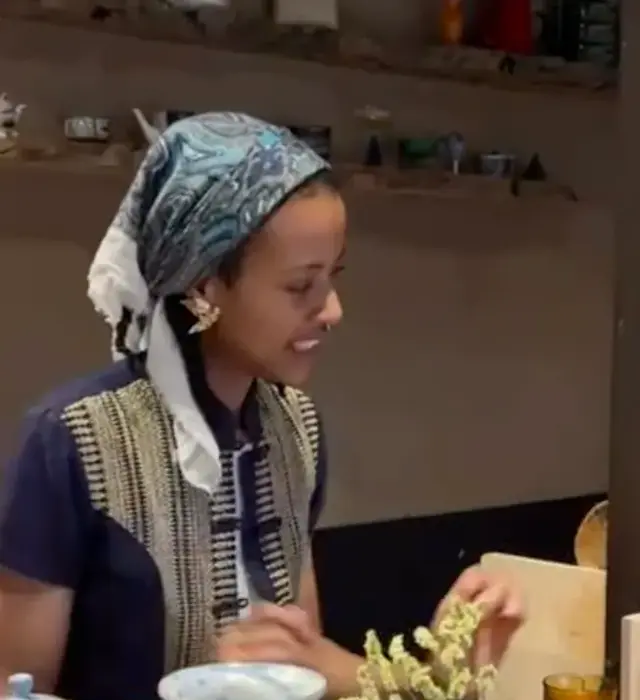
Cloudy in June (Claude)
Cloudy in June (Claude) is a ceramic artist and PhD candidate based in Kyoto. A year into her practice, she works primarily on the wheel in black and dark green clays — each piece signed with a small cloud carved by hand. (forms in [progress) and self-discovery] at NUTSHOUSE is her first solo exhibition.

Ben Kee
Ben is the founder of KWHD Singapore, a creative and maker studio in Singapore. He writes about arts, craft, makers and the spaces they build for Scaffolds Stories.